If you asked a roomful of marketing leaders to define media relations, most would give you some version of the same answer: building relationships with journalists to get press coverage.
That’s not wrong. But in 2026, it’s dangerously incomplete.
Media relations still sits at the core of public relations. It’s still about earning credibility through third-party validation. But the ecosystem it operates in has shifted so fundamentally — how people find information, how search engines evaluate authority, how AI systems decide what to cite — that the old playbook doesn’t just underperform. It actively misses the point.
Let me break down what media relations actually means today, and why it deserves a much more strategic seat at the table than most organisations give it.
The Traditional Definition (And Why It Still Holds Up)
Media relations is the practice of building and managing relationships with journalists, editors, producers, and media outlets to earn coverage that shapes public perception.
That foundation is sound. Earned media still carries a weight that paid media cannot replicate. When a respected outlet covers your company, quotes your CEO, or cites your data, it creates a layer of trust that no ad spend can buy.
What’s changed isn’t the principle. It’s the surface area.
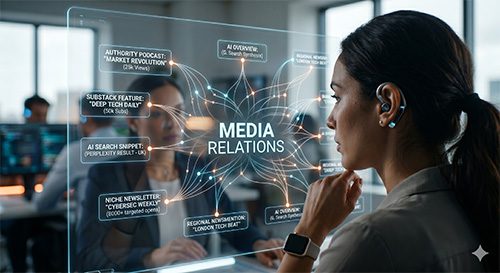
“Media” no longer means a finite list of newspapers, TV stations, and trade publications. It means podcasts with niche but deeply engaged audiences. It means newsletter operators with more influence than some legacy mastheads. It means independent journalists on Substack whose coverage gets picked up by AI-generated search summaries.
If your media relations strategy is still built around a traditional press list and a quarterly news cycle, you’re operating with a 2015 map in a 2026 landscape.
The PR + SEO Convergence: Why This Matters More Than Ever
Here’s where media relations becomes a business-critical function, not just a communications activity.
Google’s AI Overviews, Bing’s Copilot answers, Perplexity, ChatGPT search — these systems don’t just index content. They synthesise it. They pull from sources they deem authoritative and present consolidated answers, often without the user ever clicking through to a website.
This is the zero-click reality. And it changes the calculus of media relations entirely.
When an AI search engine generates an answer to “best cybersecurity platforms for mid-market companies” or “leading sustainability consultancies in the UK,” it’s drawing from a web of signals: published articles, expert quotes, brand mentions across high-authority domains, consistency of entity data across the web.
In other words, it’s drawing from exactly the kind of outputs that strong media relations produces.
Every earned media placement is now a potential input into AI-generated answers. Every quote attributed to your leadership in a respected publication strengthens your entity authority in the eyes of both traditional and AI-driven search. Every piece of original research picked up by journalists creates a citation trail that these models follow.
Media relations isn’t just about reputation anymore. It’s about discoverability in a fundamentally new information architecture.
The Authority Flywheel: A Framework for 2026 Media Relations
I use a framework I call the Authority Flywheel with clients, and it works like this:
1. Original Insight → 2. Earned Media → 3. Entity Authority → 4. AI Visibility → 5. Inbound Demand → (back to 1)
Let’s walk through it.
You start by developing a genuine point of view — proprietary data, a contrarian take grounded in evidence, original research, a framework that reframes how your market thinks about a problem. This isn’t a press release. It’s intellectual capital.
That insight fuels earned media. Journalists and editors don’t want announcements. They want angles. They want something that helps them tell a better story to their audience.
That coverage builds entity authority. Google and AI systems start associating your brand and your people with specific topics. You become a recognised node in a knowledge graph, not just another website competing for keywords.
That entity authority drives AI visibility. Your brand starts appearing in AI-generated answers, summaries, and recommendations — often in contexts where you never directly created content.
And that visibility drives inbound demand. Prospects, partners, and talent find you not because you outspent competitors on ads, but because the information ecosystem itself positions you as a credible authority.
Then you feed the flywheel again with the next piece of original insight.
This is the compounding return that media relations produces when it’s executed strategically. And it’s why treating it as a tactical “get us some press” function is leaving enormous value on the table.
What Bad Media Relations Looks Like in 2026
Since we’re being direct, let’s name what doesn’t work:
- Spray-and-pray pitching. Mass-emailing hundreds of journalists with a generic press release is not media relations. It’s spam with a comms budget. Journalists are more overwhelmed than ever, and AI tools make it easier for them to filter out noise.
- Vanity coverage chasing. Getting mentioned in a major outlet feels good. But if the coverage doesn’t connect to your strategic positioning — if it doesn’t reinforce the topics you want to own — it’s a sugar hit with no lasting value.
- Ignoring non-traditional media. A podcast with 15,000 highly targeted listeners in your industry vertical might drive more qualified authority signals than a brief mention in a national publication. Media relations in 2026 requires a broader lens.
- Treating PR and SEO as separate functions. If your PR team doesn’t understand entity SEO, and your SEO team doesn’t understand earned media strategy, you have a structural gap that neither team can close alone.
What Good Media Relations Requires Now
The organisations getting the most from media relations in 2026 share a few common traits:
They invest in original thinking. Not thought leadership as a buzzword — actual proprietary perspectives that give journalists a reason to call. Data, frameworks, informed predictions backed by expertise.
They build relationships with a broader definition of “media.” Journalists, yes. But also podcast hosts, newsletter writers, independent analysts, and content creators with domain authority.
They align PR and SEO around shared outcomes. Topical authority, entity recognition, citation in AI-generated results — these are measurable outcomes that both disciplines can drive together.
They measure beyond impressions. Reach is table stakes. What matters is whether coverage contributes to search visibility, whether your brand is surfacing in AI answers, and whether earned media is driving the authority signals that compound over time.
The Bottom Line
Media relations in 2026 is not a nice-to-have. It’s not a “brand awareness” line item you scale down when budgets get tight.
It is the mechanism by which your brand becomes a trusted entity in the information systems — human and machine — that determine who gets found, who gets cited, and who gets chosen.
The definition is simple. The execution requires more strategic sophistication than it ever has.
If you’re not connecting your media relations work to your search visibility strategy, you’re building authority in one room while the real decisions are being made in another.
Start spinning the flywheel. The compounding returns are worth it.

Bill Threlkeld is president of Threlkeld Communications, Inc., a Digital PR, SEO and Content Marketing & Measurement consultancy. Built on three-plus decades experience in Public Relations and Content Marketing. Bill’s unique value is in leveraging PR to create content “clusters” and campaigns integrating a blend of Public Relations, SEO, social media, and content that can be tracked and measured for optimized performance. Bill’s experience includes: tech, musical instrument, pro audio, legal, entertainment, apps, software, cloud services, travel, telecom, and consumer packaged goods.