
Does SEO Matter in an AI Search World?
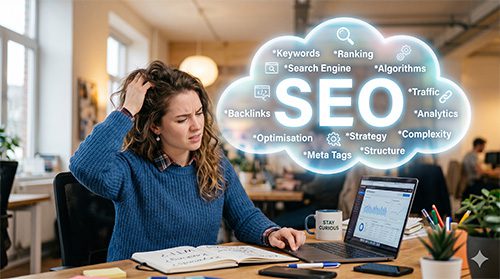
I’ve had some version of this conversation at least a dozen times in the last quarter — A CMO leans across the table (or, more often, unmutes on Zoom) and asks: “With ChatGPT and Gemini answering questions directly, is there even a point to SEO anymore?”
It’s the right question asked the wrong way.
SEO isn’t dying. But the SEO most companies are still practising? That version is already dead. And if you don’t understand the difference, you’re about to invest a lot of budget in the wrong direction.
The Old Game Is Over. Acknowledge It.
Let’s be honest about what’s happened. Google’s AI Overviews now appear on a significant and growing share of search queries. Perplexity, ChatGPT with browsing, Gemini, and Copilot are training users to expect synthesised answers, not ten blue links. Zero-click results aren’t a future threat — they’re the present default for a wide category of informational queries.
If your SEO strategy still revolves around ranking a blog post for “what is [broad topic]” and hoping someone clicks through, you’re optimising for a game that the platforms have already decided you can’t win. The AI reads your content, extracts the answer, and serves it without ever sending traffic your way.
That’s not a death sentence for SEO. It’s a death sentence for lazy SEO.
What AI Search Actually Rewards
Here’s what I’m seeing across my own clients and in the broader data: AI search engines don’t randomly generate answers. They pull from sources they deem authoritative, credible, and well-structured. That means the fundamentals of SEO — technical health, topical authority, quality content, strong backlinks — haven’t become irrelevant. They’ve become the *minimum barrier to entry* for a different kind of visibility.
The shift is this: you’re no longer optimising to be the destination. You’re optimising to be the source.
When ChatGPT cites a website in its response, or when Google’s AI Overview pulls a quote and links to it, that citation didn’t happen by accident. It happened because:
- The content demonstrated genuine expertise — original data, proprietary frameworks, clearly attributed authorship.
- The brand had broader authority signals — media coverage, citations across trusted publications, a recognisable entity in the knowledge graph.
- The content was structured for extraction — clear answers, well-organised sections, schema markup, concise definitions paired with deep analysis.
This is where PR and SEO stop being separate line items and start being the same strategy.
The PR + SEO Convergence Is No Longer Optional
For years, I’ve argued that PR and SEO are two sides of the same coin. In 2025, that’s not a philosophical position — it’s an operational reality.
AI models are trained on the open web. The information ecosystem they draw from includes news articles, industry publications, expert interviews, podcast transcripts, Wikipedia references, and authoritative brand content. If your brand only exists on your own website, you have a thin presence in the training data and a thin presence in AI-generated answers.
PR builds the off-site authority layer that AI search relies on to determine who’s worth citing.
Think about it practically:
- A feature in a respected trade publication creates a data point of credibility that an AI model can reference.
- A quoted expert opinion in a news article builds entity recognition — the AI learns that this person at this company is a credible source on this topic.
- Consistent media presence across multiple trusted domains creates the same kind of authority signal that backlinks have always provided for traditional SEO — but now it feeds directly into LLM training and retrieval-augmented generation.
If you’re a marketing leader still briefing your PR team on “brand awareness” and your SEO team on “keyword rankings” as separate objectives, you’re operating with an outdated org chart for how search actually works now.
A Framework for AI Search Visibility
Here’s a practical way to think about this. I use a simple framework with clients that I call the Authority Triangle:
- Owned Authority
Your website. Your content. This needs to be technically flawless, topically deep, and structured so AI systems can easily parse and extract information. Think of your site as a well-organised library, not a keyword farm.
- Earned Authority
Media coverage, expert commentary, guest contributions, podcast appearances, industry citations. This is traditional PR work, but with an SEO lens — targeting publications that AI systems trust, ensuring mentions include proper entity context, and building a consistent narrative around your areas of expertise.
- Entity Authority
How well does the wider web understand what your brand is and what it’s an authority on? This includes your knowledge panel, your Wikipedia presence (where applicable and appropriate), structured data across your digital properties, and the consistency of your brand’s information across the web. Entity SEO is unglamorous work, but it’s increasingly the thing that determines whether an AI model “knows” you exist.
When all three sides of the triangle are strong, you don’t just rank in traditional search — you become part of the AI’s answer layer. You get cited. You get recommended. You become the source the machine trusts.
The Queries That Still Drive Clicks
Let me also push back on the “zero-click” panic. Not every search is going zero-click. Transactional queries, complex decision-making searches, branded queries, and queries where the user *wants* depth still drive significant click-through traffic. People researching which consultant to hire, which platform to invest in, which strategy to adopt — they’re not satisfied with a three-sentence AI summary.
Your SEO strategy should deliberately shift weight toward these high-intent, high-complexity queries where click-through behaviour persists, while using informational content strategically to build the authority that gets you cited in AI answers for broader queries.
It’s a portfolio approach, not an either/or.
The Bottom Line
SEO matters more than ever in an AI search world. But it matters differently.
The companies that will dominate visibility over the next two to three years are the ones that stop treating SEO as a traffic-acquisition channel and start treating it as a credibility infrastructure — one that’s reinforced by strategic PR, built on genuine expertise, and structured for machines as much as humans.
If you’re still measuring success purely by keyword rankings and organic sessions, you’re watching the scoreboard from a game that’s already moved to a different stadium.
Start measuring whether AI search knows you exist — and whether it trusts you enough to cite you.
That’s the SEO that matters now.

Bill Threlkeld is president of Threlkeld Communications, Inc., a Digital PR, SEO and Content Marketing & Measurement consultancy. Built on three-plus decades experience in Public Relations and Content Marketing. Bill’s unique value is in leveraging PR to create content “clusters” and campaigns integrating a blend of Public Relations, SEO, social media, and content that can be tracked and measured for optimized performance. Bill’s experience includes: tech, musical instrument, pro audio, legal, entertainment, apps, software, cloud services, travel, telecom, and consumer packaged goods.